
Give a Speech!
Every service club and community group is looking for a free speaker next Thursday at lunchtime. Okay, it could be Wednesday morning at breakfast or even in Zoom. You get the point! If that is you, do not overlook a magnificent marketing opportunity.
Here is a roadmap for everything you need to know to prepare your first speech or presentation. You may find this advice will serve you for an entire career. This insight comes from a time when my hairstyling clients invited me to speak to their Rotary, Kiwanis, and Breakfast Clubs. After two talks, I realised, “This is the most fun and inexpensive way I can build my business.”
How Do You Get Invited?
Tell everyone you know you are willing and available to speak. Understand this is not a sales pitch for your company. Your message must be of interest and value. Your self-written introduction presents your credentials to the audience. Your name, company, mini bio, and speech title will be advertised to their members. Take advantage of the networking opportunity, and you can invite guests–perhaps friends, supporters, or happy clients.
Preparing Your Speech. What Do I Talk About?
Talk about what you know. Your experiences. What have you learned from your industry that could be of interest to the audience?
Begin by asking yourself these three questions:
- Who is my audience?
- What do I know about the group’s background or collective personality? Each service club has its own community, priority, or charity it supports.
- What do I know that can benefit them?

How long will I speak? They will tell you. Most likely 30 minutes.
Where Do I Find Content for My Speech?
If you’re going to address a particular group in a few weeks, keep a yellow pad handy to jot down ideas and situations related to your topic and audience. Please make a list of what you know that can benefit them, all the experiences and conditions that could serve as good (or bad) examples for others, high points and low points, failures and successes. Every day, ask yourself, “What happened of interest that may add colour to my speech?”
Have you said something on the subject to a friend or client that was particularly funny or memorable? Some of these experiences may become the original stories you use to illustrate a key point in your speech. When you sit down, outline your speech; you have plenty of material.
How Do I Outline My Talk?
Two foolproof outlines work well for both beginning and advanced speakers.
The Past-Present Journey Formula
There are many ways to add color to your presentation.
Tell your audience a three-part story:
- This is where I was.
- This is where I am.
- This is how I got here.
It’s a simple format that helps you introduce yourself and explain why you are qualified to speak on the topic you’ve chosen.
Here’s an example of how effective the outline can be. Carol was a very successful realtor and was asked to deliver a 25-minute presentation for the local Board of Realtors.
After a few minutes of conversation, I suggested she open this way: “Twelve years ago, before I went into real estate, I had never sold anything except Girl Scout cookies, and I hadn’t done that well.
Last year, I sold $58 million in a slow market, with homes averaging $300,000 each. Thank you for the opportunity to discuss how.”
Right away, the audience knew precisely what she was going to talk about, and they were eager to hear her story!
The Q&A Outline
Your audience members will want to know the answers to the same kinds of business questions you’re asked at parties or professional functions. In that case, I suggest you begin with a comment about your business and then, “The five questions I’m most frequently asked about… (investments, real estate, planning for your retirement, the value of joining Toastmasters, how to lose weight, the advice a speech coach will give you, etc.) are…
Then pose the first question to the audience and answer it in a conversational tone, as you would with a potential customer or at a party. Even though you may have never delivered a speech before, you’ve certainly had plenty of experience answering questions in your field, about your hobby, or a cause you are interested in.
An outline is essential to prepare your speech. This is because an outline gives you the structure you need to organise your talking points and make them memorable to your audience.
Or download the special report of this article.
How Do I Write My Speech?
That’s easy. To begin with, don’t. Gather and organize your thoughts, do script your opening and close, and rehearse to become comfortable. You don’t need to write your presentation down word for word because a speech that is read is not appreciated in this format. For now, jot down an outline in a notepad with key points and ideas.
Why Write Your Opening and Close?
The first and last 30 seconds of your speech will have the most impact. The purpose of your opening is to arouse interest in your subject. You want to look at your audience and engage them with your smile and opening words. You can tell if they think, “This is going to be interesting.”
If you don’t capture your audience’s interest, their attention will wander. Whatever you do, don’t waste any of your precious seconds with “Ladies and Gentlemen, it is a pleasure to be here today.” That may be polite; however, it is also dull and predictable.
Instead, open with a story, “Just last week a client asked me….”
Or a life lesson, “As a young man, my father gave me this valuable advice….”
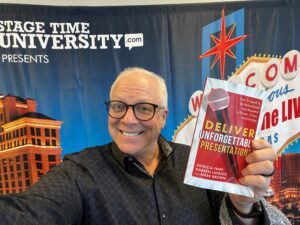
Ford Saeks loves to Deliver Unforgettable Presentations
Or an interesting statistic or little-known fact, “Would it surprise you to know that….”
Or a statement that leads to the Q&A approach, “Of all the dozens of questions I am frequently asked about…these five might interest you the most.”
My next-door neighbour, Mike Powell, was a senior scientist with Genentech working on the AIDS virus. I asked him to speak for a group of successful women in business who were all members of the Continental Breakfast Club.
I suggested that, since most of us don’t know what scientists do and may not have met any in our everyday lives, a good way to start would be to provide a high-level overview. Mike captured everyone’s attention by saying, “Being a scientist is like doing a jigsaw puzzle…in a snowstorm…at night…when you don’t have all the pieces, and you don’t have the picture you are trying to create.” Everyone sat forward! That is the purpose of a good opening. Don’t wing it.
Develop Strong Supporting Stories
If you’re using the Past-Present outline format, the middle of your talk is where you expand on your key points and develop personal stories that support where you were and where you are now.
In the Q&A format, develop one or two strong anecdotes to support each answer as an explanation and clarification. Personal anecdotes are best, but you can also insert some of the ideas and examples you’ve gathered in your earlier thinking.
Close on a High Point
Ideally, your close will be the high point of your speech. First, summarise the key elements of the investment process (or whatever your topic is). If you’re planning to take questions from the audience, say, “Before my closing remarks, are there any questions?” Answer them.
The last thirty seconds of your speech must send people out energised and fulfilled. This means you need to conclude your talk with an inspirational point that supports your theme. My scientist friend Mike talked about the frustrations of being a scientist. He closed by saying, “People often ask, ‘Why would anyone want to be a scientist?’” Then, Mike told them about a particularly information-intensive medical conference he had attended. The final speaker walked from the back of the room and said, “I am a 32-year-old wife and mother of two. I have AIDS. Please work fast.”
Mike received a standing ovation for his first speech to a lay audience. His presentation was successful because he simplified his job and framed it as a human-interest story, from both his perspective and the patients he was dedicated to helping.
Prepare to Deliver Your Speech
Review your outline and rehearse with friends or your family.
Once you have a strong outline for your talk, you’ll practice it. You may think this is too much trouble, but you’ll be glad you did. Oscar-winner Michael Caine says, “Rehearsal is the work, performance is the relaxation.”
Record yourself delivering your talk to check on timing and emphasis. Ask your friends if you have made your points clearly.
Prepare outline notes. You’re going to speak directly and spontaneously to the audience, maintaining good eye contact.
The secret is to prepare easy-to-read notes. Write your key points on a pad or card that you’ll keep on the lectern or table. Use a bold felt-tip pen or a large typeface. As you speak, you’ll follow your road map with glances if you need. Do not attempt to hide that you are using notes. Your audience will not be upset that you took the time to prepare.
An iPad or small clock on the lectern lets you keep track of the time. The good news is, nobody knows what you intended to say. Don’t get flustered if you forget an idea.
Listen for non-words. As you review your rehearsal, watch for repetitive phrases and non-words like “er” and “ah.” To sound confident, make sure you do not use phrases like “kind of” and “sort of.”
As you practice in front of a safe and friendly audience, ask for their feedback. Make it clear that you want specific suggestions, not just praise. Did they understand the points you were making? Was there a lack of logic or continuity? Did they think you spoke too quickly or too slowly? Use their feedback to polish your presentation.
Write Your Own Introduction
Write your introduction, send it in advance, and bring a printed copy! Even though you’re speaking gratis, you want your introducer to pronounce your name correctly, mention your company’s name, and let your audience know of your experience and credentials. The best introductions sell the importance of the subject before explaining why you are the best person to discuss it.
Set the Stage for Success
Arrive early. Review the room layout and test the microphone. If you have visual aids, make sure they work. Then interact with the audience before you speak. If possible, you will be well served to attend one of their meetings before the week of your presentation. Building rapport with the audience before your presentation boosts your confidence and helps you look out and see friendly faces.
Do you have a handout or brochure that will add to their retention? You may want to tell them, “If you belong to other organisations that would like to hear this presentation, please recommend me.”
Collects cards and gives out your email and website. Please give them a reason to want to go there. A special report?
Follow these guidelines to prepare your speech, and you will have fun, gain new contacts, and drive more business.
Pete Butler’s Success Story
When I began speaking to promote my men’s hairstyling salon, one of our clients, Pete Butler, heard of my adventures speaking and meeting new clients who heard me and flocked to my salon. Pete worked in the insurance industry as a financial advisor. At age 50, he trained to run the Ironman Triathlon. That got him hooked, and he participated in many interesting athletic events. I recommended him to many of the clubs that had invited me to speak.
He began his presentation by saying, “Training for a triathlon is very much like planning for your retirement.” Then Pete regaled his audience with his adventures. Having watched him on at least a dozen occasions, I could see how captivated his audiences were. To close, he said, “In the last few minutes, let me give you four questions you must ask your financial advisor about your long-term goals.”
I have seen dozens of audience members standing in line to ask questions and for his business card.
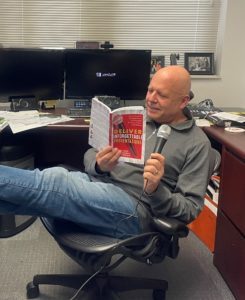
Shep Hyken rehearsing Fripp, Darren, Mark advice
Now you know the secrets of maximising your marketing opportunities.
Give a speech…as often as possible.
Frippicism: Never underestimate the power of a well-intentioned professional who realizes the power of their words.
The best way to become an effective presenter easily, quickly, and conveniently is with Patricia’s interactive online learning platform FrippVT Powerful, Persuasive Presentations.
FrippVT is a state-of-the-art, web-based training platform that emulates live training and coaching. It is almost as if Presentation Expert and Executive Speech Coach Patricia Fripp were sitting in front of you. FrippVT is designed to be immediately engaging and makes it fun to learn. If you are a novice presenter or a seasoned professional, you will find the content both practical and relevant.
Sign up for your complimentary trial and discover how FrippVT can transform you and your team. Take advantage of your free trial.
“FrippVT is the BEST investment in my speaking career. After 2 months, instead of the $300 I paid, I would have paid $3,000. For the first time in my career, I really know what I’m doing when I take the stage. My clients and audience members tell me, “Your presentations are easier to follow, and your presentation skills have vastly improved.” From FrippVT, I learned a customising technique that resulted in being hired to deliver a speech internationally.” Mitzi Perdue, Speaker, Businesswoman, and Author of Tough Man, Tender Chicken: Business and Life Lessons from Frank Perdue.
About Presentation Expert Patricia Fripp
Companies that want to drive sales and gain a competitive edge hire Patricia Fripp to help them polish their essential conversations and presentations. Kiplinger’s Personal Finance wrote, “One of the best ways to invest in your success is to learn presentation skills from Patricia Fripp.” Fripp was named one of the “Top 25 Women in Sales” and is among the “Top 30 Coaching Gurus.” Patricia is the co-author of Unforgettable Presentations.
“As a seasoned speaker, I did not believe I needed any coaching. In two hours, not only did you help me dramatically improve my important upcoming presentation, but you also showed me exactly how to do the same with all future presentations. You are an amazing speech coach and a true presentation skills expert.” Mark Stiving, Ph.D., Chief Pricing Educator, Impact Pricing
0 Comments