
My friend Michael Hauge is a Hollywood story consultant. We met 25 years ago when he came to hear me speak at the Los Angeles chapter of the National Speakers Association.
At the time, I was in my heavy-duty screenwriting-seminar days. I quoted David Freeman, who called the opening of a movie “the flavor scene,” and I related the concept to the opening of a presentation.
A distinguished-looking man in the third row raised his hand and asked, “Why are you quoting my competitors and not me?”
I replied, “Who the heck are you?”
We have been close friends and collaborators ever since.
Over the years, Michael has taught me many valuable storytelling principles. One of the most useful is: Get into the scene late.
That advice is just as valuable for speakers, executives, and sales professionals as it is for screenwriters.
Do Not Bury the Drama Beneath the Setup
Perhaps you have heard a speaker begin a story by explaining where they were, why they were there, who invited them, what day it was, what the weather was like, and what they had for breakfast.
By the time the action begins, the audience has forgotten why they were listening.
Background is valuable only when it helps the audience understand the character, the conflict, or the stakes. The goal is not to eliminate context. The goal is to provide exactly enough context to make the dramatic moment meaningful.
Specificity builds credibility. Excessive setup drains energy.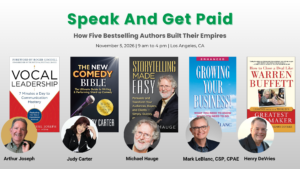
Give Us the Character, Then Disrupt the Character’s World
Imagine I begin a story with this sentence:
“Mary had a problem.”
What would you think?
Who is Mary? What is her problem? Why should I care?
Before introducing the crisis, give the audience the essential backstory:
“Mary was a seasoned HR executive. For 20 years, she had led HR departments at some of Silicon Valley’s most prestigious companies. She was regularly invited to lead panels and speak at SHRM conferences about solving complex HR problems.”
What does the audience now understand?
Mary eats problems for lunch. She is not easily rattled. If Mary faces a serious challenge, it must be significant.
That is all the setup we need.
Now get into the scene late:
“John walked into her office and said, ‘Mary, we’re going to be sued for $28 million, and I think it was my fault.’”
Immediately, we are in the scene.
We know the protagonist. We understand her credibility. We recognize the problem. Most importantly, we feel the stakes.
There is no waffle and no unnecessary runway. The story begins at the moment Mary’s normal day changes.
Begin Where the Comfortable World Changes
Hollywood stories often begin with a glimpse of an ordinary day. We see ‘a day in the life of our protagonist.’ Then an event disrupts that ordinary world.
Something happens. As a result, something else happens. As a result, another event follows. Each development creates the next. That chain of cause and effect is what keeps an audience involved.
The same principle strengthens a business story.
Do not give us the protagonist’s entire résumé. Give us the detail that establishes who the protagonist is.
Do not explain every event that occurred before the challenge. Begin as close as possible to the moment the challenge arrives.
Do not tell us a problem was serious. Let us hear the words, see the reaction, and recognize what is at risk.
A Simple Test for Your Next Story
Before delivering your story, ask:
- What is the first genuinely interesting moment?
- What must the audience know for that moment to matter?
- Which details can I remove without weakening the meaning?
- Can I begin with a line of dialogue that introduces the conflict?
- Does every event lead naturally to the next?
Your audience does not need a long journey to the scene. They need a reason to enter it.
Get into the scene late. Introduce the character quickly. Disrupt the character’s world. Then let every result lead to the next development.
The later you enter the scene, the sooner your audience may lean in.
Thank you, Michael Hauge I am excited to interview you on November 5 at UCLA.
When: Thursday, November 5, 9:00 AM – 4:00 PM
Where: UCLA Alumni Center
Featuring: Patricia Fripp (Moderator), Arthur Samuel Joseph, Michael Hauge, Judy Carter, Mark LeBlanc, and Henry DeVries.
Tickets: $247 | Early Bird: $197 before Oct 15 (includes parking). Grab your seat now before prices go up!
Learn directly from industry legends:
- Patricia Fripp – NSA Hall of Fame Speaker & Masterclass Moderator (Yes, that is me!)
- Arthur Samuel Joseph – Vocal Coach to the Stars
- Michael Hauge – Hollywood Storytelling Expert
- Judy Carter – Stand-Up Comedy & Business Star
- Mark LeBlanc – Hall of Fame Speaker & Business Growth Coach
- Henry DeVries – Forbes Columnist & Book Marketing Authority
Get real-world strategies through live talks, deep-dive interviews, and interactive Q&A sessions.

0 Comments